When you’re working on a project for a client, you’ll likely run into extra costs. Things like travel expenses, such as taxi or kilometers, but also materials, literature or shipping. If you’ve agreed with your client that these expenses can be reimbursed, you’ll need to include them on your invoice. But how do you handle these costs in your bookkeeping?
In this article, you’ll learn how to charge expenses to your client and what’s involved. Could you use some help with this? Then Kees de Boekhouder might be just what you’re looking for!
1
Charging expenses: recording in your administration
‘Charging expenses’ refers to the costs you incur while working on a project that your client has agreed to reimburse. For example, if you’re hired to paint a mural, you’ll usually agree on a fixed fee for the work itself. On top of that, you and your client may agree that materials and travel expenses will be coved by them. Since you won’t know the exact amount of these expenses until the project is finished, you’ll calculate them afterward.
From your perspective, these are simply regular business expenses. You include them in your books, they’re deductible, and you can reclaim the VAT where applicable. So far, so good.
2
Charging expenses: adding them to your invoice
Once your project is complete, it’s time to send the invoice. How do you include reimbursable expenses, and how does VAT apply?
The basic rule is simple: reimbursable expenses are considered part of the service you provide, so VAT must be charged on them. You should apply the same VAT rate as your main service on the invoice, even if the individual expenses would normally fall under a different rate. In short, one VAT rate applies to the total amount.
When adding the expenses to your invoice, list them excluding VAT. After reclaiming the VAT, this reflects the amount you actually paid. If you’re not allowed to reclaim VAT, or if you’re unable to, then include the total amount including VAT instead. Additionally, you charge the VAT rate that applies for your service.
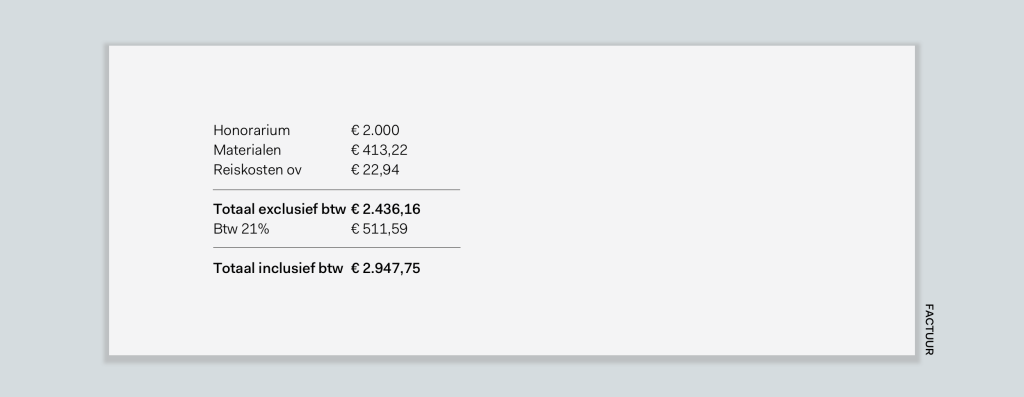
Example with 21% VAT The mural mentioned earlier is subject to 21% VAT. You agreed on a fee of €2,000. The materials you purchased cost €500 including 21% VAT (€413.22 excluding VAT), and the train ticket cost €25.00 including 9% VAT (€22.94 excluding VAT).
Image: example with 21% VAT
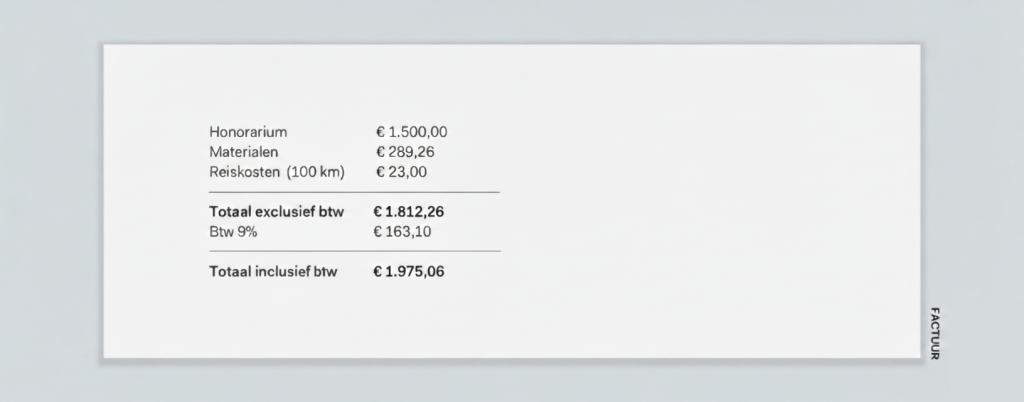
Example with 9% VAT For tangible artwork, like a painting, you charge the lower 9% VAT rate. You agreed on a fee of €1,500. The materials cost €350 including 21% VAT (€289.26 excluding VAT), and because you travel by car, you’ve agreed to charge €0.23 cents per kilometre.
Image: example with 9% VAT
3
Common mistakes
VAT errors are common when charging expenses to clients. Some entrepreneurs charge VAT on the main service but forget to include it on reimbursable expenses. Others apply a different VAT rate to the expenses than to the main service.The basic rule is simple: if the expenses are secondary to the service, apply a single VAT rate to the total amount.Do you want to be sure that you process everything correctly? Your bookkeeper can help you!
About the author: Thijmen Licht
Ready to team up?
After reading this blog, are you curious about how Kees de Boekhouder helps entrepreneurs with their bookkeeping every day? Schedule a no-obligation, digital introductory meeting with us!
Which VAT rate do I calculate on charged expenses?
You always use the same VAT percentage as your main service. The expenses are part of the total performance.
Do I calculate including or excluding VAT when charging expenses?
You calculate excluding VAT, because you reclaim the VAT on the purchase yourself. Only if you cannot reclaim the VAT, you use the amount including VAT.
How do I process the receipts in my bookkeeping?
You book the receipts as regular business expenses in your own administration. You reclaim the VAT on these receipts yourself from the Tax Authorities.
Want to know more?
We are happy to explain it to you!
Schedule a no-obligation, digital introductory meeting with us.