In this article, we’ve mapped out the most important tax deductions for zzp’ers in 2026. Feel like it’s a bit much? We get it. At Kees de Boekhouder, we guide entrepreneurs through the Dutch fiscal legislation every day. Just reach out to us and let’s get to know each other!
1
Before we dive into the deductions, let’s cover the basics. As an entrepreneur, your bookkeeping revolves around three components:
You pay tax on that profit. But here’s where it gets interesting: deductions lower this amount. They are fiscal ‘extras’ that reduce your taxable income without you actually having to spend more cash.
2
Most deductions aren’t just handed out; you have to earn them. You must meet the hourly requirement of 1,225 hours per calendar year. That’s roughly 24 hours per week. Note that all hours spent on your business count—not just billable hours. This includes administration, travel time, networking, and building your website. Accurate time tracking is your best friend if the tax authorities ever come to check on you.
3
This is the most famous one. The zelfstandigenaftrek is a fixed amount you can subtract from your profit. For 2026, this amount is set at €1,200 (down from €2,470 in 2025).
While this amount is being reduced over the coming years, it remains a direct reduction of your taxable profit. You’re entitled to this if you are seen as an entrepreneur for the income tax and meet the 1,225-hour rule. Are you reaching the state pension age (AOW-leeftijd) in 2026? Then you are entitled to half of the deduction (€600).
Example: suppose you make a profit of € 50,000. By applying the private business ownership allowance (zelfstandigenaftrek), € 48,800 remains as taxable profit. Depending on your tax bracket, this saves you hundreds of euros in income tax.
4
Did you just start as a business owner? Then you get an extra boost. The startersaftrek is an increase of the zelfstandigenaftrek. In 2026, this remains unchanged at €2,123.
You can apply this deduction a maximum of 3 times in the first 5 years of your business. As a starter in 2026, you can subtract a total of €3,323 (€1,200 + €2,123) from your profit, which is the sum of the startersaftrek and the zelfstandigenaftrek.
5
This one is a crowd favorite because you don’t need to meet the 1,225-hour requirement to claim it. As long as you are an entrepreneur for income tax purposes, you’re eligible.
For 2026, the MKB-winstvrijstelling is 12.7%.. After you’ve subtracted other deductions (like the Zelfstandigenaftrek) from your profit, you get to take another 12.7% off the remaining taxable income. Good to know: this gets deducted automatically when you fill in your tax return!
Example: Suppose you are a graphic designer with a profit of € 40,000. You meet the hourly requirement. In this case, your taxable profit is as follows:
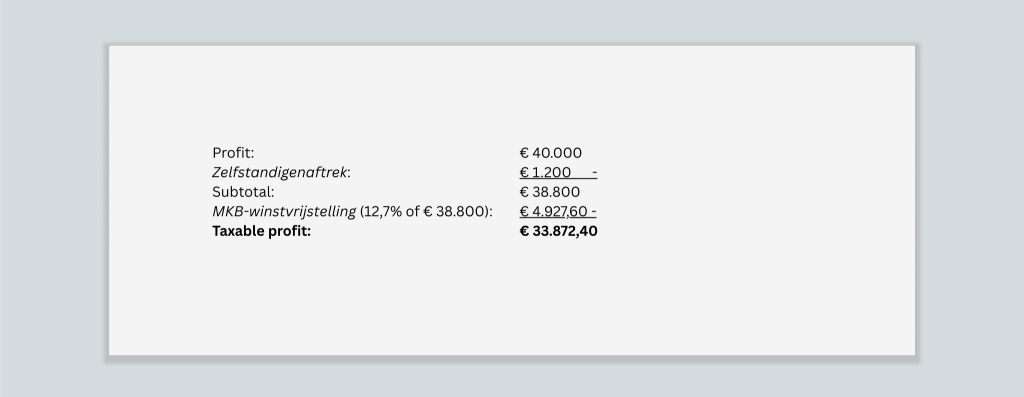
Image: example with a profit of € 40,000
Your taxable income has essentially been lowered by nearly €6,000. That’s how you grow a business!
6
The Small-projects investment credit (KIA) helps cover the costs of new investments. Whether it’s a high-end camera, a treatment chair, or a new MacBook, the KIA is an extra deduction on top of the normal depreciation. KIA is an extra deduction on top of the normal depreciation.
In 2026, you qualify for the KIA if you invest between €2,901 and €71,683. The deduction is 28% of the total investment amount. Investing more than € 71.683? Different rules apply (in Dutch)
There are a few important rules:
Example: You invest a total of € 5,000 excluding VAT in business assets. In addition to regular depreciation, thanks to the KIA (Small-scale Investment Allowance), you can deduct an extra 28% of € 5,000 = € 1,400 from your profit.
Are you just below the threshold at the end of the year? In that case, it might be beneficial to move a planned investment forward to the current year. Always have the calculation checked first to ensure it truly provides a tax advantage.
7
If you invest in energy-saving or environmentally friendly assets, the Dutch government rewards you with extra deductions that you can often “stack” with the KIA.
EIA (Energy Investment Allowance)
Investing in energy-efficient equipment or sustainable energy? The EIA offers an extra deduction on top of normal depreciation. In 2026, you can deduct an additional 40% of those costs. Conditions: the investment must be at least €2,500 and the asset must be listed on the official ‘2026 Energy List’ (in Dutch). 2026 Energy List’ (in Dutch).
MIA & Vamil (Environmental Investment)
These often go hand in hand and focus on eco-friendly assets, like an electric cargo bike. Depending on the category on the ‘2026 Environmental List (in Dutch)’ the MIA allows you to deduct up to 45% extra. The Vamil allows you to write off 75% of the investment costs whenever it suits you. This way, you could deduct the full 75% in one go during a high-profit year, giving you immediate tax relief.
ISDE (Sustainable Energy Investment Subsidy)
The ISDE is a direct cash grant from the government for things like heat pumps, solar water heaters, and insulation. Unlike the other tax deductions, the ISDE is literally an amount transferred back to your bank account.
How it works: the RVO notification
For the EIA, MIA, Vamil, and ISDE, your first point of contact isn’t the Tax Authorities, but the Netherlands Enterprise Agency (RVO). You must report your investment within 3 months of entering into the obligation (the moment you sign the quote or place the order). If you’re late, you lose the deduction!
Bonus tip: Stacking regulations
Stacking is where the real profit lies. You can almost always combine the KIA (28%) with the EIA (40%) or the MIA. However, there are two important “no-gos”: you can never use both the EIA and MIA for the same asset, and you cannot combine the EIA with the ISDE subsidy. Since you can’t benefit from the same pot twice, you’ll need to choose: you can never use both the EIA and MIA for the same asset, and you cannot combine the EIA with the ISDE subsidy. Since you can’t benefit from the same pot twice, you’ll need to choose: go for the direct cash of the ISDE, or check if the EIA deduction yields a higher tax benefit in the end.
8
WBSO (Research & Development)
Are you developing new ideas or experimenting with technology? Then the WBSO can provide a significant fiscal advantage. This allows you to deduct part of your R&D costs. In 2026, the S&O deduction for self-employed individuals is increased to €15,979 (2025: €15,738). Are you a starter in this field? Then an additional starter’s S&O deduction of €7,996 (2025: €7,875) applies. To qualify, you need an S&O declaration from the RVO and must spend at least 500 hours on recognized R&D work.
Co-working partner tax relief (meewerkaftrek)
If your fiscal partner helps out in your business regularly (at least 525 hours) without receiving a high salary (less than €5,000), you might be eligible for this. It allows you to deduct a percentage of your profit, meaning you pay less income tax. The more your partner helps, the higher the percentage. To qualify for the working partner’s deduction (meewerkaftrek), your partner must work at least 525 hours in the business, and you must meet the 1,225-hour criterion yourself. This allows you to deduct an additional portion of your profit, resulting in lower income tax. The more hours your partner contributes, the greater the tax benefit. You can find the exact percentages in the deduction table on the Dutch Tax Administration (Belastingdienst) website. Ensure you can provide proper documentation of these hours, as you must be able to present proof during an audit.
Discontinuation relief (stakingsaftrek)
When you stop your business—whether due to retirement, selling your practice, or choosing a new path—you must settle with the Tax Authorities on your ‘discontinuation profit’. The stakingsaftrek reduces this taxable profit once in your lifetime by a maximum of €3,630. You can only use this deduction once in your lifetime. If you did not use the full amount during a previous business termination, you can carry over the remaining balance to a future occasion. Calculating discontinuation relief is often complex; we strongly recommend seeking professional advice on this matter.
9
Never forget to process business expenses in your accounting again? With the Scan & Recognize from Kees de Boekhouder, tracking your spending becomes super easy!
10
Deduction | 2025 amount | 2026 amount | Main condition |
Private business ownership allowance (zelfstandigenaftrek) | € 2,470 | € 1,200 | 1,225-hour requirement |
Tax relief for new companies (startersaftrek) | € 2,123 | € 2,123 | Max 3x in first 5 years + entitlement to zelfstandigenaftrek |
SME profit exemption (MKB-winstvrijstelling) | 12.7% | 12.7% | Entrepreneur for income tax (no hour requirement) |
Small-projects investment credit (KIA) | 28% (from € 2,801) | 28% (from € 2,901) | Business assets > € 450 each |
Energy Investment Allowance (EIA) | 40% | 40% | Investment > € 2,500 + on ‘Energy List’ + report to RVO within 3 months |
Environmental Investment Allowance (MIA) | Up to 45% | Up to 45% | Investment > € 2,500 + on ‘Environment List’ + report to RVO within 3 months |
Accelerated Depreciation of Environmental Investments (Vamil) | 75% | 75% | Assets on ‘Environment List’ (Vamil-eligible) |
R&D tax credit (WBSO / S&O-aftrek) | € 15,738 | € 15,979 | 500+ hours R&D + RVO certificate |
Discontinuation relief (stakingsaftrek) | € 3,630 | € 3,630 | Once-in-a-lifetime when closing/selling your business |
Co-working partner tax relief (meewerkaftrek) | 1.25% – 4% | 1.25% – 4% | Partner works > 525 hours unpaid |

After reading this blog, are you curious about how Kees de Boekhouder helps entrepreneurs with their bookkeeping every day? Schedule a no-obligation, digital introductory meeting with us!
Kees de Boekhouder
‘Easy and clear bookkeeping software with friendly and helpful staff’
(127 reviews)
Schedule a no-obligation, digital introductory meeting with us.